When you buy through links on our articles, Future and its syndication partners may earn a commission.

Once the Artemis 2 astronauts get beyond the protective environment of Earth's atmosphere and magnetic field, they will be subject to space radiation.
While en route to and from the moon, the four-person Artemis 2 crew will be vigilant, eyeing radiation detectors and listening for caution and warning alarms. They will also be outfitted with active dosimeters, devices that measure exposure to radiation, such as X-rays or gamma rays.
Artemis 2's Orion spacecraft is relatively highly shielded. However, the astronauts would still take defensive measures if they encountered particularly high radiation levels — from a powerful solar storm, for example. The astronauts would establish a shelter utilizing central stowage bays, whose contents would be moved to a known "hot spot" within Orion. Doing so would create a lower-dose region in the capsule, helping to reduce the crew's radiation exposure.
Radiation shielding
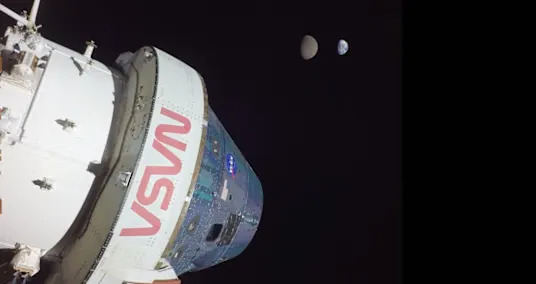
Artemis 2 will send NASA astronauts Reid Wiseman, Victor Glover and Christina Koch, and the Canadian Space Agency's Jeremy Hansen, on a roughly 10-day trip around the moon and back to Earth. NASA is targeting a launch as early as April 1.
As its name suggests, Artemis 2 will be the second mission of NASA's Artemis program. The first, Artemis 1, successfully sent an uncrewed Orion to lunar orbit and back in late 2022.
During Artemis 1, Orion spent more than 25 days in space and traveled a total of 1.4 million miles (2.25 million kilometers), gathering a wealth of valuable data about the deep-space environment and the capsule's performance within it.

"From the measurements on Artemis 1, we learned that the Orion is a good vehicle to be in during a radiation storm, as it is compact and dense and hence offers up good radiation shielding," said Stuart George, radiation instrumentation lead at NASA's Space Radiation Analysis Group (SRAG), based at Johnson Space Center in Houston.
"We learned that the Orion radiation storm shelter performs as expected and at different locations in the vehicle," George told Space.com.

Artemis 1 carried an instrument-laden manikin and two torso-only "body phantoms," which showed that doses to internal organs can be much lower than doses to skin during space weather events, said George.
The radiation exposure of the Artemis 2 crew will be gauged by Hybrid Electronic Radiation Assessors (HERA) and by small Crew Active Dosimeter badges that the crew will wear. There are six active HERA sensors deployed at various spots inside the Orion crew module.
Additionally, NASA has again partnered with the German Space Agency DLR, using an updated model of its M-42 sensor — an M-42 EXT — for Artemis 2. The new version — four of which will fly on Orion during Artemis 2 — offers six times more resolution to distinguish between different types of energy, compared to the Artemis 1 version.

Shelter in place
What about "go, no-go" decision-making for Artemis 2 in regards to dealing with a space weather or other space radiation event?
"Wile background galactic cosmic rays are difficult to shield from due to their high energies, solar particle events generated by the sun are a different matter," George said.
For solar particle events, NASA has predefined radiation dose rate levels after which the crew will work to construct a radiation shelter to reduce their exposure, said George.

If that dose rate threshold is exceeded, he added, the Artemis 2 crew would take material out from spacecraft storage bays and place those objects along the least shielded wall of the Orion capsule to build a radiation shelter.
"In addition, if an event is particularly bad, there are some places in the capsule, such as storage bays and down by the toilet, that the crew can go to," said George. Such areas would be pretty tight but would offer up even more shielding.
latest_posts
- 1
 New movies to watch this weekend: See 'Predator: Badlands' in theaters, rent 'Black Phone 2,' stream Guillermo del Toro's 'Frankenstein' on Netflix
 - 2Doctors looking into hormone therapy as a way to ward off dementia in women
- 37 Delightful Ferris Wheels, Do You Like Them?
- 4How to watch ‘The Traitors’ Season 4: Premiere date, episode release time, full cast list and more
- 5Where You Could Sleep With Snorlax in Japan, From MIMARU’s Pokémon Rooms to Grand Hyatt Tokyo’s Limited Pokémon Suite


- Dependable Savvy Locks to Update Your Home Security
- Nestlé recalls infant formula in 49 countries. See list.
- Exploring the School Application Cycle: Understudy Bits of knowledge
- EU waters down plans to end new petrol and diesel car sales by 2035
- Ukraine demands army of 800,000 under peace plan
- Step by step instructions to Deal with Your Time While Chasing after an Internet based Degree
- Aspect Biosystems receives funding for cellular medicine project
- Ergonomic Office Seats for Work spaces
- Inside Plan with Houseplants: An Aide