When you buy through links on our articles, Future and its syndication partners may earn a commission.

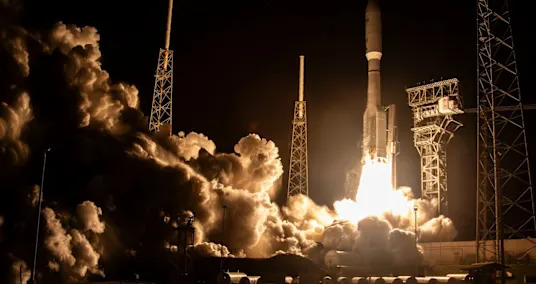
A United Launch Alliance (ULA) Atlas V rocket will launch its heaviest-ever payload on Saturday morning (April 4), and you can watch the action live.
The Atlas V is scheduled to lift off Saturday at 1:45 a.m. EDT (0545 GMT) from Florida's Cape Canaveral Space Force Station, carrying 29 satellites for the Amazon Leo broadband constellation to orbit. Together, those spacecraft weigh 18 tons, according to ULA.
You can watch it live here at Space.com, courtesy of ULA, or directly via the company. Coverage will begin 20 minutes before launch.

The Amazon Leo megaconstellation, previously known as Project Kuiper, will eventually consist of about 3,200 satellites in low Earth orbit. It's Amazon's answer to SpaceX's Starlink network, which beams internet service down from more than 10,000 satellites (and counting).
Amazon Leo is still in its early stages; just 212 of the spacecraft have reached orbit to date over the course of eight launches (not counting a 2023 liftoff that sent up two prototype satellites).
The Atlas V has flown four of those operational missions. Three employed SpaceX's Falcon 9, and the other one used Arianespace's Ariane 6 heavy lifter.
Saturday's launch, which Amazon calls LA-05, will be the first Atlas V mission to loft 29 Amazon Leo satellites; the others carried 27 of the spacecraft.
"The increase is a result of detailed engineering work between Amazon Leo and ULA, and is made possible by a new, higher-performing version of the RL10C engine used on the rocket's Centaur upper stage," Amazon representatives wrote in a mission description. "While the engine has flown on previous missions, LA-05 marks the first time the program has completed the extensive engineering and safety analysis required to use it with our larger payload."
And that payload is larger in a significant way, according to the LA-05 mission description: "With 29 satellites aboard, LA-05 will mark the heaviest payload ever flown on an Atlas V."
latest_posts
- 1
 Massive supernova explosion may have created a binary black hole
 - 2How effective is the flu shot this year? New report shows promising results
- 3Seoul says sorry after unapproved drone flights into North Korea
- 4Investigating Inside Plan and Home Style: Change Your Residing Space
- 5Discovering a true sense of harmony: Contemplation and Care Practices





- Tehran defends ship seizure as a legal action, but tensions continue in the Gulf
- Ancient eggshells shed new light on crocodiles that hunted prey from trees
- Find the Insider facts of Viable Advertising: Building a Positive Brand Picture
- Nature's Best: A Manual for Beautiful Train Rides
- Most loved Seared Chicken: Which Chain Rules?
- Easy to understand Tech: Cell phones for Old in 2024
- Fundamental Home Exercise center Hardware: Amplify Your Exercises
- Charlotte faith leaders hold interfaith forum on Black and Palestinian solidarity
- Step by step instructions to Pick A Keep money with High Fixed Store Loan costs


